
At a glance
- Teduglutide, sold as Gattex, is a prescription drug for short bowel syndrome, in which too little working intestine remains to absorb food and fluid 1, 2.
- It is not a weight-loss, wellness or performance peptide. Its label gives a single use, short bowel syndrome 1.
- It is a 33-amino-acid analog, a modified copy, of glucagon-like peptide-2 (GLP-2), a hormone the intestine makes, and it is given by injection under the skin 3.
- FDA approved it on December 21, 2012 4. Its label covers adults and children 1 year and older "who are dependent on parenteral support," nutrition or fluids given into a vein 1, 2.
- In the main adult trial, 27 of 43 patients on teduglutide and 13 of 43 on placebo, a dummy injection, cut their weekly intravenous volume by at least 20 percent 3.
- JumpstartMD does not prescribe teduglutide.
Evidence strength
- No published studies found
- Animal or lab only
- Early human studies
- Human trials
- Approved for a use
FDA's label reports two placebo-controlled trials in adults with short bowel syndrome, of 86 and 84 patients, and a 59-patient study in children 3.
What is teduglutide?
Teduglutide is a prescription drug for short bowel syndrome, sold under the brand name Gattex 4, 1. The condition is a "malabsorptive condition characterized by an extreme reduction in functional intestinal length" 2. In plain words, too little working intestine remains to absorb the food and fluid a person needs 2. In the main adult trial, the bowel had most often been removed by surgery because of blood-vessel disease or Crohn's disease 3.
Some patients with the condition cannot stay nourished and hydrated by eating and drinking alone 2. They rely on parenteral support, which the long-term study defines as "parenteral nutrition and/or intravenous fluids" 2. That means nutrition or fluid infused into a vein through a catheter, in the main trial's patients for a mean of 6 years 2, 3.
The molecule is a chain of 33 amino acids, the building blocks of proteins 3. It is an analog, a modified copy, of human glucagon-like peptide-2 (GLP-2) 3. The label calls GLP-2 "a peptide secreted by L-cells of the distal intestine," meaning that cells in the far end of the gut release it 3. Teduglutide is made in bacteria modified by recombinant DNA technology, that is, given the genetic instructions to build it 3.
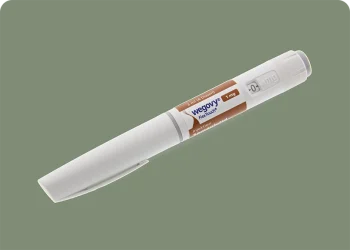
Teduglutide's label says the drug binds "glucagon-like peptide-2 receptors" 3. The current Wegovy (semaglutide) label says that drug "activates the GLP-1 receptor" and calls GLP-1 "a physiological regulator of appetite and caloric intake" 5.
Is teduglutide FDA-approved?
Yes, as a prescription drug for one condition 4, 1. FDA approved Gattex (teduglutide) on December 21, 2012, under new drug application NDA 203441 4. Its marketing status is "Prescription" as of November 9, 2026, the date of the Drugs@FDA record's data 4.
The current label, revised in September 2025, carries a single indication 1. Gattex "is indicated for the treatment of adults and pediatric patients 1 year of age and older with Short Bowel Syndrome (SBS) who are dependent on parenteral support" 1. The label lists no other use 1. Drugs@FDA tags the application "Orphan," FDA's term for a drug for a rare disease, and the authors of the long-term study point to "the rarity of the condition" 4, 2.
See the FDA status of every peptide, updated weekly.
How does teduglutide work?
The label says natural GLP-2 "is known to increase intestinal and portal blood flow and inhibit gastric acid secretion" 3. Portal blood flow is the blood passing from the gut to the liver. Teduglutide binds GLP-2 receptors on hormone-releasing cells, supporting cells and nerves in the intestinal wall 3. Activating them releases local signals, among them insulin-like growth factor 1 (IGF-1), nitric oxide and keratinocyte growth factor 3.
The effect measured in people is on absorption 3. A 21-day open-label study, in which everyone knew what was given, tested several doses in 17 adults with short bowel syndrome 3. All but the lowest dose raised fluid absorption by about 750 to 1,000 milliliters a day 3. Those doses also "increased villus height and crypt depth of the intestinal mucosa," the folds and pits of the gut lining that take up nutrients 3.
The label gives teduglutide's mean half-life as about 1.3 hours in people with short bowel syndrome and about 2 hours in healthy people 3. A half-life is the time for half of the drug to leave the blood.
What does the research show?
FDA approved teduglutide for short bowel syndrome, and every efficacy trial on its label enrolled patients who depended on parenteral support 3, 1. Two were placebo-controlled trials in adults and one a study in children, each followed by an extension 3.
The main adult trial was randomized, double-blind and placebo-controlled 3. Chance decided who received teduglutide and who received placebo, and neither patients nor doctors knew which 3. It enrolled adults who had depended on intravenous nutrition or fluids for at least 12 months and needed parenteral nutrition at least three times a week 3. Their mean age was 50 3. Before randomization, investigators brought each patient's intravenous volume down to a stable minimum 2, 3.
Then 86 patients were randomized, 43 to teduglutide and 43 to placebo, each injected under the skin once daily for 24 weeks 3. A responder was a patient whose weekly intravenous volume fell by at least 20 percent at both week 20 and week 24 3. By that measure, 27 of 43 patients on teduglutide (63 percent) responded, against 13 of 43 on placebo (30 percent) 3. The difference was unlikely to be chance (p=0.002) 3.
At week 24, mean weekly volume had fallen by 4.4 liters in the teduglutide group, from a starting 12.9 liters 3. In the placebo group it had fallen by 2.3 liters, from 13.2 liters 3. The label adds: "Twenty-one patients on GATTEX (54%) versus 9 on placebo (23%) achieved at least a one-day reduction in PN/I.V. support," its term for intravenous nutrition and fluids 3. The label does not state the group sizes behind those percentages 3.
A second placebo-controlled trial of 24 weeks had three groups: 35 patients on the dose later recommended, 33 on twice that dose, and 16 on placebo 3. Its primary measure, a graded score, "did not achieve statistical significance for the high dose" 3. On the 20 percent response measure, 46 percent of patients on the recommended dose responded, against 6 percent on placebo 3. The label gives no primary-measure result for the recommended dose and reports the 46 against 6 percent as a "further evaluation," with no p-value 3.
Weekly volume fell by 2.5 liters in both teduglutide groups and by 0.9 liters in the placebo group 3. Two patients on the recommended dose came off parenteral support by week 24 3.
Studied in people over the long term: a two-year open-label extension of the main trial, in which all 88 participants received teduglutide and knew it 2. Of the 88, 37 had taken teduglutide in the main trial, 39 had taken placebo, and 12 had qualified but were never randomized 2. Sixty-five patients (74 percent) completed the extension 2.
Among those who finished, 28 of the 30 treated for up to 30 months were responders, with a mean reduction of 7.6 liters a week 2. Of the former placebo patients who finished, 16 of 29 responded, with a mean reduction of 3.1 liters a week 2. Four of the 6 never-randomized patients who finished responded 2. Thirteen patients came off parenteral support completely: 10, 2 and 1 in the three groups 2.
That extension had no comparison group, and its authors say what follows from that 2. "Because this extension study was not placebo-controlled, we cannot rule out the possibility that observed reductions in PS were partially caused by spontaneous adaptation," they wrote, PS being parenteral support 2. The study was funded by NPS Pharmaceuticals 2. The paper appeared online on February 4, 2016 2.
The extension also reported body weight, in patients whose intravenous nutrition was being reduced 2. Mean body weight and body mass index (BMI), weight relative to height, "remained constant": the mean change at the end of treatment was a loss of 0.4 kilograms 2. "Episodes of weight decrease" were recorded as adverse events in 22 of the 88 patients (25 percent), none of them serious 2. With no placebo group, the study cannot show what teduglutide itself did to weight 2. The authors concluded that "Overall health and nutritional status was maintained despite PS reductions" 2.
The 2021 label's table for the two placebo-controlled trials reports no body-weight result 3. It lists decreased appetite in 7 percent of patients on teduglutide and 3 percent on placebo 3.
In children, a 24-week study enrolled 59 patients aged 1 through 17 who depended on parenteral support 3. Patients chose teduglutide or standard care; 9 took standard care, and the rest were randomized, double-blind, to one of two doses 3. The label reports results for the 26 on the recommended dose, of whom 18 (69 percent) cut their parenteral volume by at least 20 percent 3. Three of the 26 (12 percent) reached "enteral autonomy," meaning they came off parenteral support 3. The label gives no result for the standard-care group, so those figures have no comparator beside them 3.
The current label says safety and effectiveness in children under 1 year of age "have not been established" 1. None of the sources cited here studies teduglutide for weight loss, muscle, aging or athletic performance 2, 1.
What are the side effects?
The 2021 label's main table pools the two placebo-controlled adult trials: 77 patients on the recommended dose and 59 on placebo, over 24 weeks 3. Abdominal pain was reported by 30 percent on teduglutide and 22 percent on placebo, and nausea by 23 and 20 percent 3. Upper respiratory tract infection was reported by 21 and 12 percent, and abdominal distension, a swollen belly, by 20 and 2 percent 3. Injection site reactions (13 and 12 percent), vomiting (12 and 10) and fluid overload (12 and 7) follow 3. Hypersensitivity, a group of reactions that includes rash and itching, was reported by 10 and 7 percent 3.
Intestinal obstruction and gallbladder inflammation appeared only in the teduglutide groups of those trials 3. Six patients had an intestinal obstruction, a blockage of the bowel: 3 of 77 on the recommended dose, 3 of 32 on twice that dose, and none on placebo 3. Three patients on teduglutide developed cholecystitis, an inflamed gallbladder, against none on placebo; all three had earlier gallbladder disease 3.
Fluid retention was more common on the drug 3. Peripheral edema, swelling from retained fluid, affected 8 of 77 patients on teduglutide and 2 of 59 on placebo 3. Two patients on teduglutide developed congestive heart failure, in which the heart cannot keep up with the body's fluid load 3. Among patients with a stoma, a surgical opening of the bowel onto the abdomen, 13 of 31 on teduglutide had a stoma complication, against 3 of 22 on placebo 3.
Three patients in the adult studies were diagnosed with cancer, all of them men taking teduglutide in the extension 3. One had metastatic adenocarcinoma, a gland-cell cancer that had spread, of unconfirmed origin after 11 months of treatment 3. It came two decades after abdominal radiation for Hodgkin's disease 3. Two, with "extensive smoking histories," had lung cancers 3. The extension's authors wrote that each of the three "had a significant risk factor for malignancy" 2.
Three patients died during the extension: one after catheter-related sepsis, and two of the three men with cancer 2. Investigators reported the adenocarcinoma as treatment related because a causal link "could not be ruled out" 2.
Fourteen adults in the studies were found to have polyps, growths on the lining of the gut, after starting study treatment 3. In the placebo-controlled trials the count was 1 of 59 patients on placebo and 1 of 109 on teduglutide 3. The other 12 cases arose in the extension studies, where every patient took the drug 3.
In the 88-patient extension, serious adverse events occurred in 56 patients (64 percent), and investigators judged those of 9 patients related to teduglutide 2. The most common events of any kind were abdominal pain (34 percent), catheter sepsis (28 percent) and episodes of weight decrease (25 percent) 2. Catheter sepsis is a bloodstream infection from the intravenous line, and the authors did not consider the serious catheter events related to the drug 2. In 41 children given the recommended dose in a 24-week and a 12-week study, the 2021 label says the safety profile "was similar to that in adults" 3.
The current label lists no contraindications: the section reads "None" 1. Its first warning is headed "Acceleration of Neoplastic Growth," neoplastic meaning new abnormal tissue, benign or cancerous 1. It reads: "Based on the pharmacologic activity and tumor findings in the rat and mouse carcinogenicity studies, GATTEX has the potential to cause hyperplastic changes including neoplasia" 1.
The 2021 label reports two-year studies in rats and mice at many times the human exposure 3. Male rats developed benign tumors of the bile duct and small intestine, and mice of the gallbladder 3. Male mice at the highest dose developed intestinal cancers 3.
The current label continues: "In patients at increased risk for malignancy, the clinical decision to use GATTEX should be considered only if the benefits outweigh the risks" 1. For adults it calls for "colonoscopy and upper GI endoscopy with removal of polyps," camera examinations of the lower and upper gut, within 6 months before starting 1. It recommends a follow-up "at the end of 1 year of GATTEX," then "every 5 years or more often as needed" 1. Since approval, colorectal, gastric and small intestinal polyps have been reported in patients on the drug 1. "If gastrointestinal cancer is diagnosed, discontinue GATTEX therapy," the label tells prescribers 1.
The current label's other warnings cover intestinal obstruction, disease of the gallbladder, bile ducts and pancreas, and fluid overload 1. It attributes the fluid overload and heart failure seen in the trials to "enhanced fluid absorption associated with GATTEX" 1. It adds that stopping the drug "may also result in fluid and electrolyte imbalance" 1. It calls for tests of "bilirubin and alkaline phosphatase" and of "lipase and amylase" within 6 months before starting and "at least every 6 months while on GATTEX" 1.
Because teduglutide increases absorption, the current label warns of "increased absorption of concomitant oral medications," medicines taken by mouth at the same time 1. In the adult trials, one patient taking prazepam, a benzodiazepine, "experienced a dramatic deterioration in mental status progressing to coma during the first week of GATTEX therapy" 1. The coma resolved 5 days after both drugs were stopped 1.
Antibodies to teduglutide were found in 14 of 29 adults tested at 30 months 1. The current label says they have "not been associated with clinically relevant safety findings, reduced efficacy or changed pharmacokinetics" 1. Case reports in pregnancy "have not identified a drug-associated risk of major birth defects, miscarriage, or adverse maternal or fetal outcomes" 1. It says "breastfeeding is not recommended during treatment with GATTEX" 1.
In sport
Teduglutide is not named on the 2026 Prohibited List of WADA, the World Anti-Doping Agency 6. The list's section S2 covers "Peptide hormones, growth factors, related substances, and mimetics," and neither teduglutide nor GLP-2 appears among its named examples 6. S2's examples are introduced by the words "Including, but not limited to," and S2 also carries the clause "other substances with similar chemical structure or similar biological effect(s)" 6.
What JumpstartMD offers
JumpstartMD does not prescribe teduglutide. Our peptide library covers it so you have the facts on its FDA status and the evidence, current as of November 10, 2026.
Book FREE Consultation
Share your details and a JumpstartMD team member will reach out shortly. Or call 408.478.3496 for your free, no-obligation consultation.
Share your details and a JumpstartMD team member will reach out when we open.
Disclaimer
Compounded medications are not FDA-approved, and FDA does not review their safety, effectiveness, or quality before they are marketed. A licensed clinician decides after an evaluation whether a peptide is appropriate for you, and not every patient will qualify.
Frequently Asked Questions
Is teduglutide a weight-loss peptide?
No. FDA approved it only for short bowel syndrome in patients who depend on nutrition or fluids given into a vein 1. Its label says it binds "glucagon-like peptide-2 receptors," and the current Wegovy (semaglutide) label says that drug "activates the GLP-1 receptor" 3, 5. In an 88-patient extension study with no placebo group, mean body weight stayed constant 2.
What is Gattex used for?
Gattex is the brand name of teduglutide 4. Its label gives one use: treating adults and children 1 year and older with short bowel syndrome "who are dependent on parenteral support" 1. In the main adult trial, more patients on teduglutide than on placebo cut their weekly intravenous volume by at least 20 percent 3.
Does teduglutide cause cancer?
The current label warns that it "has the potential to cause hyperplastic changes including neoplasia," based on how the drug works and on tumors in rats and mice 1. Three patients in the adult studies were diagnosed with cancer 3. The extension's authors wrote that each "had a significant risk factor for malignancy" 2. For adults, the current label calls for a colonoscopy and an upper endoscopy before treatment and at intervals during it 1.
References
- Takeda Pharmaceuticals America, Inc., "Gattex (teduglutide) for injection, for subcutaneous use: Prescribing information," revised Sept. 2025 (NDA 203441), via DailyMed. [Online]. Available: https://dailymed.nlm.nih.gov/dailymed/drugInfo.cfm?setid=66b69c1e-b25c-44d3-b5ff-1c1de9a516fa [Accessed: Nov. 10, 2026]. ↩
- L. K. Schwartz et al., "Long-Term Teduglutide for the Treatment of Patients With Intestinal Failure Associated With Short Bowel Syndrome," Clinical and Translational Gastroenterology, vol. 7, no. 2, p. e142, Feb. 2016, doi: 10.1038/ctg.2015.69. [Online]. Available: https://pmc.ncbi.nlm.nih.gov/articles/PMC4817413/ [Accessed: Nov. 10, 2026]. ↩
- Shire-NPS Pharmaceuticals, Inc., "GATTEX (teduglutide) for injection, for subcutaneous use: Prescribing information," revised Jan. 2021 (NDA 203441/S-018). [Online]. Available: https://www.accessdata.fda.gov/drugsatfda_docs/label/2021/203441s018lbl.pdf [Accessed: Nov. 10, 2026]. ↩
- U.S. Food and Drug Administration, "Drugs@FDA: FDA-Approved Drugs," NDA 203441 (Gattex Kit, teduglutide; Takeda Pharms USA), approved Dec. 21, 2012, marketing status "Prescription," data updated Nov. 9, 2026. [Online]. Available: https://www.accessdata.fda.gov/scripts/cder/daf/index.cfm?event=overview.process&ApplNo=203441 [Accessed: Nov. 10, 2026]. ↩
- Novo Nordisk Pharmaceutical Industries, LP, "Wegovy (semaglutide) injection, for subcutaneous use; Wegovy (semaglutide) tablets, for oral use: Prescribing information," revised June 2026 (NDA 215256 and NDA 218316), via DailyMed. [Online]. Available: https://dailymed.nlm.nih.gov/dailymed/drugInfo.cfm?setid=ee06186f-2aa3-4990-a760-757579d8f77b [Accessed: Nov. 10, 2026]. ↩
- World Anti-Doping Agency, "The 2026 Prohibited List, International Standard," effective Jan. 1, 2026. [Online]. Available: https://www.wada-ama.org/en/prohibited-list [Accessed: Nov. 8, 2026]. ↩