








In a Nutshell
Not FDA-approved, and available only on a prescription. Sold "for research only" means no pharmacy, no prescription and no one to call, and FDA has told such a seller that its products are unapproved drugs 10. BPC-157 and five other peptides can be made for you by a licensed pharmacy on a licensed clinician's prescription. The Department of Health and Human Services (HHS) said so on October 30, 2026 1. It does not intend to act against that, under an interim policy that is not binding 2.
Status as of November 8, 2026Next scheduled review: Monday, November 16, 2026
The six peptides in the news,
and sermorelin
Status as of
Not FDA‑approved · prescription only
Each of the six, BPC-157, TB-500, MOTS-c, KPV, Epitalon and Semax, is not FDA-approved. A licensed pharmacy may compound it for you on a clinician's prescription. Since October 30, 2026 HHS has said it does not intend to take enforcement action against that, under an interim policy that is not binding, with ten conditions 1,2.
Not FDA‑approved · prescribed today
Latest change
On October 30, 2026 HHS published a draft, interim enforcement-discretion policy for six compounded peptides. Public comments close November 13, 2026. Nothing changes for patients on that date 1.
Legal, FDA-approved,
or neither?
Are peptides legal?
It depends on the peptide and on how you get it. Some peptides are FDA-approved medicines, and the six in the news may now be compounded for you on a prescription. Buying any of them online "for research" is outside that policy; FDA treats such sales as unapproved drugs when the product is meant for people.
Three words do the work on this page.
Approved. FDA has reviewed a medicine and allowed it to be sold. The approved peptide medicines are named in the next answer.
Compounded. A licensed pharmacy made the medicine for you alone, on your clinician's prescription. FDA says plainly that "compounded drugs are not FDA-approved" 8. Section 503A is the part of federal law that allows that kind of pharmacy to do so 2.
Enforcement discretion. The six peptides, BPC-157, TB-500, MOTS-c, KPV, Epitalon and Semax, are not approved. FDA flagged them for safety concerns from 2023 until April 2026 3, and until October 30, 2026 no policy covered compounding them 1. On that date the federal government published a notice saying HHS "does not intend to take enforcement action" against a licensed pharmacy or physician that compounds them for a named patient 1. That is what enforcement discretion means: the government says it does not intend to act against licensed pharmacies that do this, not that it is allowed.
What it is not. The policy behind the notice sets ten conditions for that, listed under "What changed in October 2026" below, and it is a draft. In its own words it "does not establish any rights for any person and is not binding on HHS or the public" 1. For you that means a pharmacy can make them for you today, and HHS could change its mind.
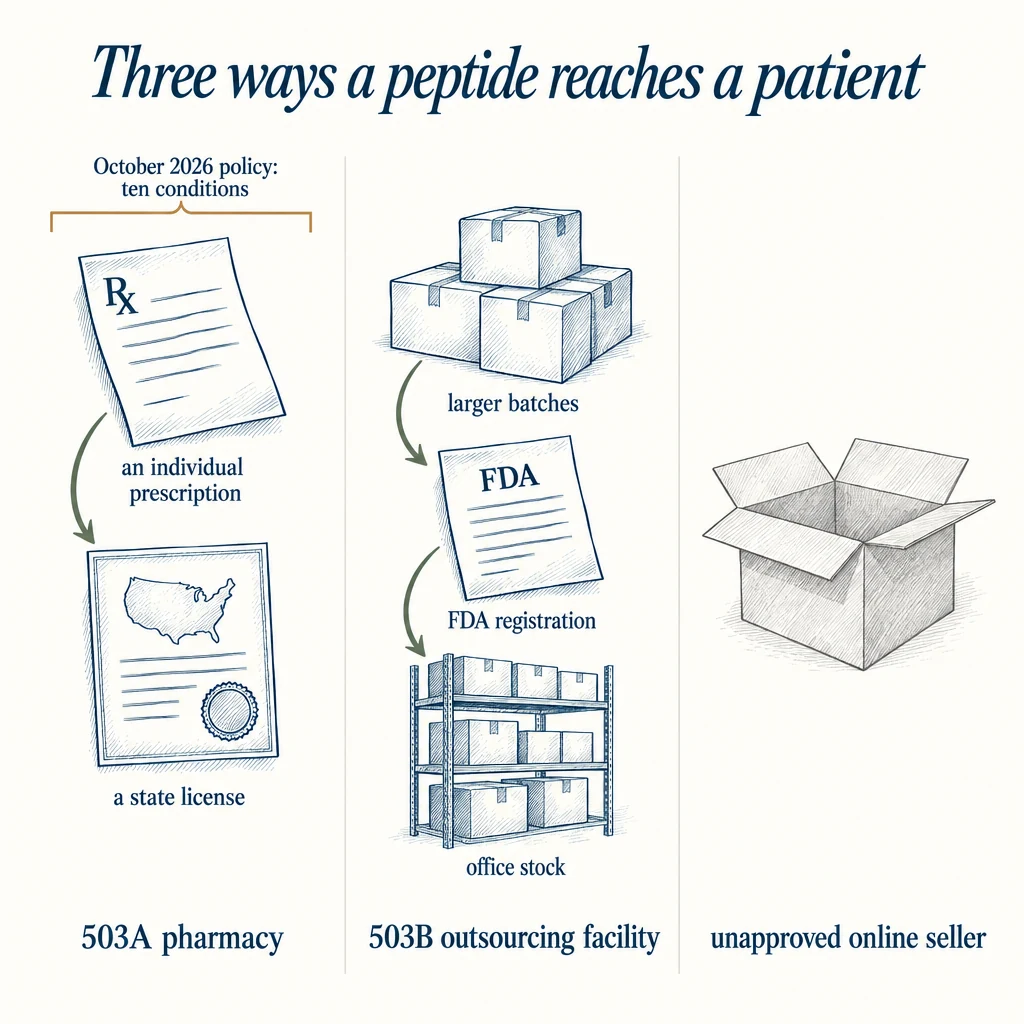
Websites selling peptides "for research only" are a different matter. FDA has told such a seller that its website "establishes that your products are intended to be drugs for human use", which makes them unapproved drugs, whatever the label says 10.
Which peptides are FDA-approved?
Some are. Semaglutide (Wegovy) 20, tirzepatide (Zepbound) 21 and tesamorelin (Egrifta) 12 are FDA-approved peptide medicines. None of the six in the October 2026 policy is approved.
FDA's advisory committee on compounding looked at seven peptides on July 23 and 24, 2026 7. The first day covered BPC-157, TB-500, MOTS-c and KPV, the second emideltide (DSIP), Semax and Epitalon. It voted for six of them. HHS's policy names those six, and emideltide is not in it 2. A committee vote is advice, not approval. Sermorelin stands apart: once approved as Geref, now compounded, so not FDA-approved today; its story is under "Is sermorelin FDA-approved?" below 11,8. Tesamorelin is FDA-approved as a biologic; FDA's word for a biologic's approval is a license 12.
What changed
in October 2026
What did the FDA and HHS change in October 2026? Is the FDA cracking down on peptides?
The opposite of a crackdown, and done by a draft policy rather than a rule. On October 30, 2026 HHS said it does not intend to act against licensed pharmacies and physicians that compound six peptides for named patients, if ten conditions are met 1,2.
The story behind it is short. In September 2023 FDA put these six, with other peptides, on Category 2 3. That is FDA's list of compounding ingredients flagged for safety concerns, and the reason was that little or nothing was known about their safety in people. Each had been nominated for FDA's list of allowed compounding ingredients, and in April 2026 the nominators withdrew. FDA's reviewers still "recommended against listing" any of them 2. In July 2026 FDA's advisory committee on compounding voted for the six anyway 7. In October HHS acted on that vote, "to expand and improve patient access" and to "discourage the continued, widespread use of certain research-use-only peptides supplied by foreign manufacturers" 1,2. It did not approve the six, and it did not ban them. It "may revisit" the policy "if, among other things, a safety signal or product quality issue arises" 1.
The ten conditions, in plain words 2:
- The peptide is one of the six.
- The pharmacy uses the exact form, and the exact uses, that HHS describes.
- The raw ingredient comes from a factory registered with FDA and arrives with a test certificate for identity, purity, strength and contaminants.
- That factory, not a middleman, is the one FDA has registered; it follows FDA's manufacturing rules and its address is on the certificate.
- The pharmacy reports what it makes, and any serious reaction or quality problem, to FDA and to the state.
- The label says "This is a compounded drug product. Not for resale."
- The medicine contains one active ingredient, not a blend.
- If it is taken by mouth, the pharmacy must show the body can absorb it.
- The only device packed with it is an FDA-cleared syringe.
- And it is made for you, on your prescription, under every other rule that already applied.
How to get peptides
legally
How can I get peptides legally?
Through a licensed clinician who evaluates you and writes a prescription, filled by a licensed pharmacy that makes the medicine for you. For the six peptides no route the policy covers skips those two people.
Federal law requires a compounded medicine to be made for a named patient on a valid prescription, and HHS's policy keeps that as its tenth condition 2. The pharmacy must be licensed in its state, must buy its raw ingredient from a factory registered with FDA, and must have that ingredient tested 2. In California a pharmacy that makes injectable medicines may not use any ingredient labeled "not for human use" or "not for injectable use" 13. A pharmacy outside California may not ship injectable compounded medicines into the state without a California license for that 15. Websites that sell "research" peptides are not pharmacies. FDA has told such a seller that its products are drugs for human use and therefore unapproved drugs, and no label changes that 10. If you have been using the online kind, say so at your consultation; it is part of your history.
Research peptides vs prescription peptides: what is the difference?
A prescription peptide is made for you by a licensed pharmacy after a clinician's evaluation. A "research" peptide is sold online by a seller whose label says it is not for people, and nobody has checked what is in the vial.
Who decides
- Prescription
- A licensed clinician, after an evaluation
- “Research use only”
- Nobody; you buy it
Who makes it
- Prescription
- A state-licensed pharmacy, for you
- “Research use only”
- An unknown seller
Testing
- Prescription
- Required: a certificate for identity, purity, strength and contaminants 2
- “Research use only”
- None required
Status
If something goes wrong
- Prescription
- Your clinician follows up; serious reactions are reported to FDA 2
- “Research use only”
- No one to call
"What does RUO mean?" Research use only. It is a seller's label saying the product is not for people, and FDA decides what a product is really for from the whole website, not the label 10. "What is the most legit peptide company?" The better question is which pharmacy. A legitimate one is licensed in your state, fills a prescription, holds a test certificate for the ingredient, and works with a clinician who follows up.
How much do prescription peptides cost?
An evaluation at JumpstartMD is a visit with a licensed clinician who takes your history, including any peptides you have bought online, and decides whether a peptide fits you. The peptide therapy membership is $29 a month; the clinical assessment and the medication are priced separately, and the clinic quotes both when you book. Results vary from person to person.
Downsides,
and who should avoid peptides
What are the downsides of peptides? Who should avoid them?
For the six peptides nobody knows the full list of downsides, because the human studies are few or missing. FDA's reviewers flagged the same gaps for each: possible immune reactions, impurities, and too little human data to say whether the drug would cause harm 3.
FDA's sentence on KPV is the plainest: it "has not identified any human exposure data" and "lacks important information regarding any safety issues raised by KPV, including whether it would cause harm if administered to humans" 3. It says the same of TB-500 and MOTS-c, and of BPC-157, Epitalon and Semax that it "lacks sufficient information to know whether the drug would cause harm" 3. The standards body for medicines, USP, added on November 3, 2026 that the six have no official quality standard, so even a well-made batch cannot be measured against one 16. If you feel unwell after a peptide, tell your clinician. The pharmacy must report serious reactions to FDA under the policy 2.
Who should avoid them. Your clinician decides whether a peptide is appropriate for you, and not every patient will qualify. Tested athletes: see the sports section.
The six, one by one,
and sermorelin
Each of the six, BPC-157, TB-500, MOTS-c, KPV, Epitalon and Semax, is not FDA-approved. A licensed pharmacy may compound it for you on a clinician's prescription. Since October 30, 2026 HHS has said it does not intend to take enforcement action against that, under an interim policy that is not binding, with ten conditions 1,2. Each sat from September 2023 until April 22, 2026 on Category 2, FDA's list of compounding ingredients flagged for safety concerns 2,3; HHS records that "neither the placement nor the removal changed its status under section 503A", the law on making a medicine for one patient 2. FDA's reviewers said no and its advisory committee said yes in July 2026; the policy followed, for one form of each only 2,7. Ask about any of them at a consultation; our clinician decides after an evaluation whether it fits you.
BPC-157
- Form the policy covers
- BPC-157 acetate 2.
- FDA's safety words
- FDA has
no, or only limited
safety information for its proposed uses. It flagged possible immune reactions and impurities and said itlacks sufficient information to know whether the drug would cause harm when administered to humans
3. - In sport
- On WADA's 2026 Prohibited List (S0, non-approved substances), prohibited at all times 17.
TB-500
- Form the policy covers
- TB-500 acetate 2.
- FDA's safety words
- No human studies of this fragment have reached FDA. It flagged possible immune reactions and impurities and said it
lacks important information regarding any safety issues raised by this drug
3. - In sport
- On WADA's 2026 Prohibited List (S2, as a thymosin-β4 derivative), prohibited at all times 17.
MOTS-c
KPV
- Form the policy covers
- KPV acetate 2.
- FDA's safety words
- No human studies of it have reached FDA, which said it
lacks important information regarding any safety issues raised by KPV, including whether it would cause harm if administered to humans
3. - In sport
- Not named on WADA's 2026 Prohibited List; a tested athlete asks their anti-doping body first 17.
Epitalon
- Form the policy covers
- Epitalon acetate 2.
- FDA's safety words
- FDA found no safety information for its use and flagged possible immune reactions and impurities. It
lacks sufficient information to know whether the drug would cause harm if administered to humans
3. - In sport
- Not named on WADA's 2026 Prohibited List; a tested athlete asks their anti-doping body first 17.
Semax
- Form the policy covers
- Semax free base 2.
- FDA's safety words
- FDA has
no, or limited
safety information for it and flagged possible immune reactions and impurities. Itlacks sufficient information to know whether the drug would cause harm if administered to humans
3. - In sport
- Not named on WADA's 2026 Prohibited List; a tested athlete asks their anti-doping body first 17.
Sermorelin
- Status
- Not FDA-approved today as a compounded medicine. A licensed clinician can prescribe it and a licensed pharmacy can compound it for you, because its ingredient was part of an approved medicine 2,6. Not in the October 2026 policy; its history is under
Is sermorelin FDA-approved?
. - Safety
- Ask your clinician about sermorelin's side effects before you start; FDA has said the approved form, Geref (sermorelin acetate), was not withdrawn for safety reasons 11.
- In sport
- On WADA's 2026 Prohibited List (S2.2.4, growth hormone releasing factors), prohibited at all times 17.
What about GHK-Cu, CJC-1295 and other peptides?
None of these is FDA-approved and none is in the October 2026 policy. GHK-Cu, in forms that are not injected, is on Category 1, FDA's list of nominated ingredients still under review, restored on May 14, 2026 4. FDA will ask its advisory committee about it before the end of February 2027 4. Its injectable form was withdrawn from review 3. In September 2024 the nominations for CJC-1295 and ipamorelin were withdrawn and both left Category 2 5. FDA still took the question to its advisory committee, as it had announced, and the committee voted against ipamorelin, 0 to 12, on October 29, 2024 22, and against CJC-1295, 0 to 13, on December 4, 2024 23. Ipamorelin acetate stays on Category 2 for larger compounding facilities 3. Any of them reaches a patient only the way the six do, through a clinician and a licensed pharmacy.
Is sermorelin FDA-approved? Can my doctor prescribe it?
Not today, and yes. Sermorelin was an FDA-approved medicine, Geref, until FDA withdrew the approvals in 2009, after its maker stopped selling it in 2008 11. Today it is made as a compounded medicine, which is not FDA-approved, and a licensed clinician can prescribe it 8.
Geref was approved in 1990 as a test of growth hormone function and in 1997 for children with growth hormone deficiency 11. When the company discontinued it, FDA checked why and found in 2013 that it was "not withdrawn from sale for reasons of safety or effectiveness" 11. That finding is one reason a pharmacy may still compound sermorelin on a prescription. The other is that its ingredient was part of an approved medicine 2, and FDA's own list for larger compounders marks sermorelin acetate as one of the "components of FDA approved drugs" 6. It is not one of the six in the October 2026 policy and did not need to be. JumpstartMD prescribes sermorelin after a clinical evaluation. For tested athletes it is on the World Anti-Doping Agency's list; see the sports section 17.
What happened,
and what is next
Newest first. The page updates as the sources change.
- November 13, 2026
Public comments close 1.
Nothing changes for patients on that day.
- October 30, 2026
HHS publishes notice of its draft, interim enforcement-discretion policy for the six 1.
- July 23–24, 2026
- April 22, 2026
- September 2023
What happens next?
If you hold a prescription for one of the six, nothing changes on November 13, 2026. That is the day public comments on the policy close 1. After it, HHS can keep, change or withdraw the policy. FDA may also write a final rule that puts each peptide on, or off, its list of allowed compounding ingredients 2.
The date comes from the notice, two weeks after October 30 1. The hour, 11:59 p.m. Eastern, is regulations.gov's, as read by our team on November 8, 2026 19. HHS says "FDA's future rulemakings may propose adding some or all of these peptides" to that list 1. FDA has also said it will consult its advisory committee before the end of February 2027 about GHK-Cu, a peptide outside the six 4. HHS may revisit the policy "if, among other things, a safety signal or product quality issue arises" 1.
Sports
and drug tests

Are peptides banned in sports? Can they show on a drug test?
Yes, three of the six are, for tested athletes. The World Anti-Doping Agency (WADA), whose list governs tested sport, names BPC-157, TB-500 and MOTS-c as prohibited at all times 17,18. It also lists sermorelin, tesamorelin, CJC-1295 and ipamorelin among growth hormone releasing factors 17. Epitalon, KPV and Semax are not named, which is not a clearance. A prescription alone does not make a listed peptide allowed; a tested athlete needs a therapeutic use exemption 18. Whether a test detects a given peptide is a question for your anti-doping body. The list, not the test, decides what counts.
Get Started with JumpstartMD
JumpstartMD's clinicians prescribe sermorelin, and our peptide program can evaluate you for BPC-157, TB-500, MOTS-c, KPV, Epitalon and Semax under the current federal policy. Every one is a compounded medicine, not FDA-approved, prescribed only after an evaluation, and not every patient will qualify. We do not sell research peptides and we do not publish doses. If HHS withdraws or narrows its policy, pharmacies could stop compounding the six; your clinician would talk through what that means for you.
Book FREE Consultation
Share your details and a JumpstartMD team member will reach out shortly. Or call 408.478.3496 for your free, no-obligation consultation.
Share your details and a JumpstartMD team member will reach out when we open.
The details
California
California's rules do not name the six, and the Board of Pharmacy's compounding FAQ, revised January 2026, does not mention the October policy (read November 8, 2026) 14. The state's own compounding rules, in force since October 1, 2025, add to the federal ones: a pharmacy making injectable medicines may not use an ingredient labeled "not for pharmaceutical use", "not for injectable use" or "not for human use", and must confirm every ingredient is suitable for sterile use 13,14. A pharmacy outside California "shall not compound sterile drug products for shipment into this state" without a California license for it 15. Whether a particular pharmacy can lawfully make one of the six for you is a question for that pharmacy's license and your clinician.
503A and 503B
A 503A pharmacy makes a medicine for one named patient on a prescription. A 503B outsourcing facility makes larger batches under FDA registration and its own list of allowed ingredients. HHS's October 2026 policy is written for the first kind only, "a State-licensed pharmacy, Federal facility, or licensed physician" 1. Nothing in it changes what a 503B facility may make.
What the policy does not do
It does not approve the six, because "compounded drugs are not FDA-approved" 1,8. It does not ban them. It does not reach websites selling "research" vials, which FDA treats as unapproved drugs when they are meant for people 10. It does not put the six on FDA's list of allowed compounding ingredients; only a final rule can, and none exists 2. It does not bring back compounded semaglutide or tirzepatide, which FDA says "do not currently appear on the 503B bulks list or on FDA's drug shortage list" as of April 1, 2026 9. And it is not final. It "does not establish any rights for any person and is not binding on HHS or the public" 1.
Editorial Standards
Every date and quotation on this page comes from the primary sources listed below. No news report is a source here.
This page is checked against its sources every week. Next scheduled review: Monday, November 16, 2026.
Written by JumpstartMD's medical content team. Reviewed by Dr. Sean Bourke MD.
Compounded medications are not FDA-approved, and FDA does not review their safety, effectiveness, or quality before they are marketed. A licensed clinician decides after an evaluation whether a peptide is appropriate for you, and not every patient will qualify.
References
- Department of Health and Human Services, "Enforcement Discretion Policy Regarding 503A Compounding Using Certain Peptide Bulk Drug Substances," Federal Register, vol. 91, pp. 68526-68527, Oct. 30, 2026. Docket No. HHS-OASH-2026-0496. [Online]. Available: https://www.govinfo.gov/content/pkg/FR-2026-10-30/html/2026-22192.htm [Accessed: Nov. 8, 2026]. ↩
- Department of Health and Human Services, "HHS Enforcement Discretion Policy Regarding 503A Compounding Using Certain Peptide Bulk Drug Substances, with Appendix A and Appendix B," Oct. 2026. [Online]. Available: https://www.hhs.gov/sites/default/files/hhs-503a-peptide-enforcement-discretion-policy-appendix-b.pdf [Accessed: Nov. 8, 2026]. ↩
- U.S. Food and Drug Administration, "Certain Bulk Drug Substances for Use in Compounding that May Present Significant Safety Risks," Apr. 22, 2026. [Online]. Available: https://www.fda.gov/drugs/human-drug-compounding/certain-bulk-drug-substances-use-compounding-may-present-significant-safety-risks [Accessed: Nov. 8, 2026]. ↩
- U.S. Food and Drug Administration, "Bulk Drug Substances Nominated for Use in Compounding Under Section 503A of the Federal Food, Drug, and Cosmetic Act," May 14, 2026. [Online]. Available: https://www.fda.gov/media/94155/download [Accessed: Nov. 8, 2026]. ↩
- U.S. Food and Drug Administration, "Bulk Drug Substances Nominated for Use in Compounding Under Section 503A of the Federal Food, Drug, and Cosmetic Act," Sep. 27, 2024 (archived). [Online]. Available: https://web.archive.org/web/20241107074712id_/https://www.fda.gov/media/94155/download [Accessed: Nov. 8, 2026]. ↩
- U.S. Food and Drug Administration, "Bulk Drug Substances Nominated for Use in Compounding Under Section 503B of the Federal Food, Drug, and Cosmetic Act," Mar. 21, 2025. [Online]. Available: https://www.fda.gov/media/94164/download [Accessed: Nov. 8, 2026]. ↩
- U.S. Food and Drug Administration, "July 23-24, 2026: Meeting of the Pharmacy Compounding Advisory Committee," Aug. 6, 2026. [Online]. Available: https://www.fda.gov/advisory-committees/advisory-committee-calendar/july-23-24-2026-meeting-pharmacy-compounding-advisory-committee-07232026 [Accessed: Nov. 8, 2026]. ↩
- U.S. Food and Drug Administration, "Compounding and the FDA: Questions and Answers," Sep. 16, 2025. [Online]. Available: https://www.fda.gov/drugs/human-drug-compounding/compounding-and-fda-questions-and-answers [Accessed: Nov. 8, 2026]. ↩
- U.S. Food and Drug Administration, "FDA clarifies policies for compounders as national GLP-1 supply begins to stabilize," Apr. 1, 2026. [Online]. Available: https://www.fda.gov/drugs/drug-alerts-and-statements/fda-clarifies-policies-compounders-national-glp-1-supply-begins-stabilize [Accessed: Nov. 8, 2026]. ↩
- U.S. Food and Drug Administration, "Warning Letter: Warrior Labz SARMS, MARCS-CMS 655280," Jun. 12, 2023. [Online]. Available: https://www.fda.gov/inspections-compliance-enforcement-and-criminal-investigations/warning-letters/warrior-labz-sarms-655280-06122023 [Accessed: Nov. 8, 2026]. ↩
- U.S. Food and Drug Administration, "Determination That GEREF (Sermorelin Acetate) Injection, 0.5 Milligrams Base/Vial and 1.0 Milligrams Base/Vial, and GEREF (Sermorelin Acetate) Injection, 0.05 Milligrams Base/Amp, Were Not Withdrawn From Sale for Reasons of Safety or Effectiveness," Federal Register, vol. 78, pp. 14095-14096, Mar. 4, 2013. Docket No. FDA-2012-P-1071. [Online]. Available: https://www.govinfo.gov/content/pkg/FR-2013-03-04/html/2013-04827.htm [Accessed: Nov. 8, 2026]. ↩
- U.S. Food and Drug Administration, "Drugs@FDA: BLA 022505, EGRIFTA (tesamorelin acetate), licensed Nov. 10, 2010; former NDA deemed a BLA Mar. 23, 2020," Accessed Nov. 2026. [Online]. Available: https://www.accessdata.fda.gov/scripts/cder/daf/index.cfm?event=overview.process&ApplNo=022505 [Accessed: Nov. 8, 2026]. ↩
- California State Board of Pharmacy, "Final Order of Adoption: Compounding, 16 CCR §§ 1735-1738," Jun. 17, 2025 (effective Oct. 1, 2025). [Online]. Available: https://www.pharmacy.ca.gov/laws_regs/1735_38_oa.pdf [Accessed: Nov. 8, 2026]. ↩
- California State Board of Pharmacy, "Frequently Asked Questions: Compounding Regulations," Jan. 2026. [Online]. Available: https://www.pharmacy.ca.gov/online/faqs [Accessed: Nov. 8, 2026]. ↩
- Cal. Bus. & Prof. Code § 4127.2, "Nonresident pharmacy; sterile compounding pharmacy license," Division 2, Chapter 9, Article 7.5. [Online]. Available: https://leginfo.legislature.ca.gov/faces/codes_displaySection.xhtml?lawCode=BPC§ionNum=4127.2 [Accessed: Nov. 8, 2026]. ↩
- United States Pharmacopeia, "USP statement on quality and safety considerations for unapproved peptides," Nov. 3, 2026. [Online]. Available: https://www.usp.org/news/usp-statement-on-quality-and-safety-considerations-for-unapproved-peptides [Accessed: Nov. 8, 2026]. ↩
- World Anti-Doping Agency, "The Prohibited List 2026, World Anti-Doping Code International Standard," Sep. 2025 (in force Jan. 1, 2026). [Online]. Available: https://www.wada-ama.org/sites/default/files/2025-09/2026list_en_final_clean_september_2025.pdf [Accessed: Nov. 8, 2026]. ↩
- U.S. Anti-Doping Agency, "What is the MOTS-c peptide?," Jan. 16, 2024. [Online]. Available: https://www.usada.org/spirit-of-sport/what-is-mots-c-peptide/ [Accessed: Nov. 8, 2026]. ↩
- Regulations.gov, "Docket HHS-OASH-2026-0496," 2026. [Online]. Available: https://www.regulations.gov/docket/HHS-OASH-2026-0496 [Accessed: Nov. 8, 2026]. ↩
- U.S. Food and Drug Administration, "Drugs@FDA: NDA 215256, WEGOVY (semaglutide), approved Jun. 4, 2021," [Online]. Available: https://www.accessdata.fda.gov/scripts/cder/daf/index.cfm?event=overview.process&ApplNo=215256 [Accessed: Nov. 8, 2026]. ↩
- U.S. Food and Drug Administration, "Drugs@FDA: NDA 217806, ZEPBOUND (tirzepatide), approved Nov. 8, 2023," [Online]. Available: https://www.accessdata.fda.gov/scripts/cder/daf/index.cfm?event=overview.process&ApplNo=217806 [Accessed: Nov. 8, 2026]. ↩
- U.S. Food and Drug Administration, "Pharmacy Compounding Advisory Committee Meeting, October 29, 2024: Final Summary Minutes," [Online]. Available: https://www.fda.gov/media/185412/download [Accessed: Nov. 8, 2026]. ↩
- U.S. Food and Drug Administration, "Pharmacy Compounding Advisory Committee Meeting, December 4, 2024: Final Summary Minutes," [Online]. Available: https://www.fda.gov/media/185642/download [Accessed: Nov. 8, 2026]. ↩