

In a Nutshell
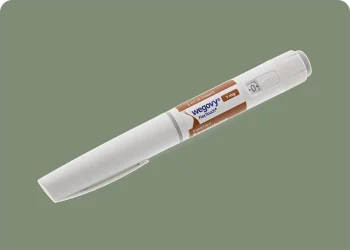
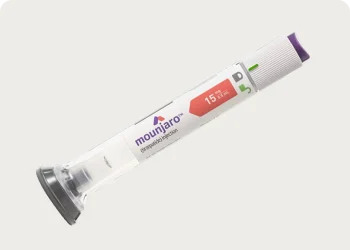
GLP-1 medications for weight loss are started at a low dose and increased in slow, scheduled steps — a process called titration — to let your body adjust and keep side effects manageable. The FDA labels for Wegovy®, Zepbound®, Ozempic®, and Mounjaro® all use a once-weekly injection with a 4-week minimum at each step before going higher 1, 2, 3, 4. Wegovy reaches its 2.4 mg maintenance dose over 16 weeks; Zepbound can take up to 20 weeks to reach its 15 mg maximum 1, 2.
The single most important idea on this page: the goal is the lowest dose that produces meaningful weight loss with manageable side effects — not the maximum dose as fast as possible. Higher is not automatically better. In a large real-world obesity clinic, only about 23% of semaglutide users and 28% of tirzepatide users ever reached the maximum dose 7 — most people do well below it.
Every dose change is a clinical decision your prescriber makes with you, based on your response, side effects, and medical history. Adjusting a dose on your own — or buying extra to "speed things up" — can trigger severe nausea, vomiting, dehydration, and kidney injury. This page explains how the schedules work and why; it is not instructions to adjust your own dose.
How the Titration Schedules Work (by Medication)
All four are once-weekly subcutaneous injections taken on the same day each week. Two are FDA-approved for weight management — semaglutide (Wegovy®) and tirzepatide (Zepbound®) — while Ozempic® (semaglutide) and Mounjaro® (tirzepatide) are the type 2 diabetes versions of the same molecules, sometimes prescribed off-label for weight (see how GLP-1 medications work and semaglutide vs tirzepatide).
The tables below come directly from each product's current FDA prescribing information — the label schedule. Your clinician may move more slowly, but should not move faster.
Semaglutide (Wegovy®) — weight management
| Weeks | Once-weekly dose |
|---|---|
| 1–4 | 0.25 mg (starting dose — not therapeutic) |
| 5–8 | 0.5 mg |
| 9–12 | 1 mg |
| 13–16 | 1.7 mg |
| 17 onward | 2.4 mg (recommended maintenance) |
The maintenance dose is 2.4 mg or 1.7 mg once weekly 1. The 0.25 mg starting dose exists to reduce GI side effects and is not meant to drive weight loss on its own 1.
Tirzepatide (Zepbound®) — weight management
| Weeks | Once-weekly dose |
|---|---|
| 1–4 | 2.5 mg (initiation only — not a maintenance dose) |
| 5–8 | 5 mg |
| then +2.5 mg every ≥4 weeks as decided by your clinician | up to 15 mg |
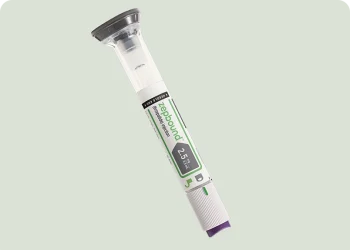
The recommended maintenance dose is 5 mg, 10 mg, or 15 mg once weekly, increased in 2.5 mg steps after at least 4 weeks on the current dose 2. Reaching 15 mg therefore takes a minimum of about 20 weeks 2.
The diabetes versions (Ozempic® and Mounjaro®)
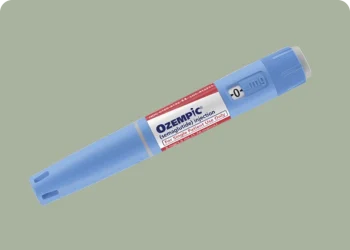
Ozempic (semaglutide) steps from 0.25 mg → 0.5 mg → 1 mg → a maximum of 2 mg weekly, at least 4 weeks apart 3. Mounjaro (tirzepatide) follows the same 2.5 mg → 5 mg → up to 15 mg schedule as Zepbound 4. Both are approved for type 2 diabetes.
Oral note: in December 2025 the FDA approved an oral semaglutide for chronic weight management — the first GLP-1 pill cleared for obesity; oral semaglutide (Rybelsus®) is also used in diabetes. Oral forms have their own escalation schedules and are likewise clinician-managed.
Why Escalation Is Slow on Purpose
The 4-week steps are not arbitrary — slow escalation is the main reason most people can stay on these medications. When the dose rises too fast, three problems compound:
- Gastrointestinal side effects intensify and persist instead of settling. Nausea, vomiting, diarrhea, and constipation cluster in the weeks right after a dose increase (see nausea and digestive side effects).
- Dehydration and kidney strain can follow from vomiting and reduced fluid intake — occasionally severe enough to cause acute kidney injury.
- People quit. Intolerable side effects are a leading reason patients abandon treatment before it can work.
A measured pace lets your gut adapt at each level, which is why the labels require a minimum 4-week hold per step and let clinicians go slower. If you don't tolerate a step, the Wegovy label directs prescribers to consider delaying the next increase by 4 weeks 1.
"Highest Tolerated Effective Dose" Is the Target — Not the Maximum
This is the core answer to the two questions patients ask most — "How should doses be titrated?" and "Should I keep increasing my dose?" — and it's the same principle: find the lowest dose that produces a clinically meaningful response, then stay there.
Reaching the maximum is not a goal in itself, and most people never need it. In a real-world obesity clinic, only about 23% of semaglutide patients and 28% of tirzepatide patients reached the top dose 7. The standard maintenance doses are highly effective on their own — in STEP 1, semaglutide 2.4 mg produced a mean −14.9% body weight at 68 weeks versus −2.4% with placebo 6.
There's also a strategic reason to avoid rushing to the ceiling: dose headroom. If you're already maxed out and your weight loss plateaus, there's no higher dose to move to — so settling at an effective mid-range dose keeps an extra lever in reserve (see expected weight loss timeline).
Does more medication mean more weight loss? On average, somewhat — but with a tradeoff. The STEP UP trial tested an investigational 7.2 mg semaglutide dose against the standard 2.4 mg over 72 weeks: the higher dose produced more weight loss, but gastrointestinal events and dysesthesia (abnormal skin sensations such as tingling) were more frequent 5. More effect and more side-effect burden — which is why dosing is individualized, not maximized by default.
The 12-Week Response Check
A useful milestone in obesity medicine is the 12-week reassessment. After roughly 12 weeks at your maximum tolerated dose, your clinician evaluates your response — a common benchmark is whether you've lost at least 5% of your starting body weight, the threshold generally considered clinically meaningful. If you haven't, the recommended order is: (1) confirm you're truly at your maximum tolerated dose and taking it consistently; (2) review lifestyle factors — protein, resistance training, sleep, alcohol, other medications; (3) consider combination therapy; then (4) consider switching medications — generally last, not first.
This 12-week / 5% framing is an obesity-medicine practice convention, not a verbatim FDA rule — the Wegovy and Zepbound labels set no numeric stopping threshold. The closest label precedent is the older Saxenda® (liraglutide) label, which directs clinicians to reassess at 16 weeks and discontinue if the patient hasn't lost at least 4% of baseline weight 8. The principle is the same: response-based reassessment, not indefinite escalation.
When NOT to Increase the Dose
Going up is not the right move in several common situations — recognizing them is part of why supervision matters.
- Side effects from the last increase haven't settled — persistent nausea, vomiting, or reflux usually means hold, not advance.
- You're losing weight steadily at your current dose — if it's working, there's often no reason to climb.
- You're dehydrated, eating very little, or unwell — increasing on top of this raises the risk of kidney injury.
- You've missed multiple doses — you may need to step down and re-escalate (see below), not jump back.
- A new medical issue, surgery, or pregnancy plan has come up — some situations call for pausing or stopping; see pregnancy and fertility.
Missed Doses and Restarting: What the Labels Say
Missed-dose rules differ by medication, so the number of days matters. Current label instructions 1, 2, 3, 4:
| Medication | If a dose is missed |
|---|---|
| Wegovy® | If the next scheduled dose is more than 2 days (48 hours) away, take the missed dose as soon as possible. If it is less than 2 days away, skip it and resume on schedule. |
| Ozempic® | Take the missed dose within 5 days; if more than 5 days have passed, skip it and resume on schedule. |
| Zepbound® / Mounjaro® | Take the missed dose within 4 days (96 hours); if more than 4 days have passed, skip it and resume on schedule. |
After a longer gap, restarting is a clinical decision. The Wegovy label notes that if 2 or more consecutive doses are missed, you may resume as scheduled or reinitiate and follow the escalation schedule again — restarting low can reduce the GI symptoms that come with resuming 1. After about 2 or more weeks off, talk with your prescriber about how to restart rather than injecting your old dose 1. This restart planning is a routine part of clinically supervised GLP-1 care.
Maintenance and Microdosing as Clinical Strategies
Once you reach a dose that's working, you enter maintenance — staying at the lowest effective dose for as long as the medication is part of your plan. There's no fixed maintenance number: for some it's 1.7 mg of Wegovy, for others 2.4 mg; for tirzepatide it may be 5, 10, or 15 mg 1, 2.
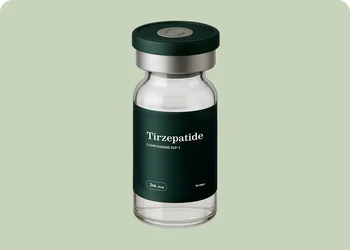
"Microdosing" — doses below the standard schedule — is a term you'll see online, often tied to compounded products. It's sometimes used clinically for highly side-effect-sensitive patients, maintenance, or tapering, but only as a deliberate, supervised strategy — not a way to stretch a vial. The biggest risks come from compounded vial-and-syringe products where the person draws their own dose, a setup linked to dosing errors and overdoses (see compounded semaglutide safety). When you come off the medication, a planned step-down matters too — see stopping GLP-1s and weight regain.
Is This Normal? When to Call Your Clinician
Some discomfort after a dose increase is expected. Contact your clinician — before your next injection — if nausea or vomiting lasts more than a few days or keeps you from drinking fluids; you're losing weight very rapidly (more than ~2% of body weight per week) or feel weak and lightheaded; you've missed two or more doses and aren't sure how to restart; or you're at your maximum dose and side effects feel unsustainable (stepping down is a legitimate option, not a failure).
Red Flags — Seek Care Now
Go to an emergency department or call 911 for:
- Severe, persistent abdominal pain — especially radiating to your back, with or without vomiting (possible pancreatitis).
- Inability to keep down any fluids, with dizziness, dark urine, or markedly reduced urination (severe dehydration / acute kidney injury).
- Signs of a severe allergic reaction — swelling of the face, lips, tongue, or throat; trouble breathing.
These risks rise sharply with too-fast escalation and unsupervised dosing. See serious side effects and red flags.
What You Can Do About It
- Take it the same day each week, and don't double up after a missed dose — follow your medication's missed-dose rule.
- Don't chase the maximum. If you're losing weight and tolerating your dose, that is success — let your clinician decide whether to climb.
- Support each step: prioritize protein and resistance training to protect lean mass (see muscle-loss prevention), eat smaller meals, and stay hydrated — your best defense against the side effects that make escalation hard.
- Report side effects early so your plan can hold or step down before you feel like quitting.
- Never source or adjust doses on your own. Self-escalation and compounded vial dosing are where the serious harms cluster.
Get Started with JumpstartMD
If you're unsure whether your dose is right — too high, too low, or stalled — that's exactly the question a supervised program is built to answer.
JumpstartMD was founded in 2007 by Stanford-trained physicians, with programs built around labs, hormones, and body composition and peer-reviewed outcomes published in the Journal of Obesity. You're seen face-to-face by licensed clinicians — in person at 14 California locations or online across California — not handed a one-size-fits-all dose by an app.
Care starts with a 60-biomarker lab screening and contraindication screening before any prescription, plus drug-interaction monitoring. Your titration is clinician-managed: doses are escalated, held, or stepped down based on your response and tolerance, with restart protocols if you miss doses and a step-down/taper plan to protect results afterward. InBody® body-composition scanning each visit tracks lean mass so you lose fat, not muscle — up to 40% of weight lost on GLP-1s can be muscle without supervision. FDA-approved options include Ozempic®, Wegovy®, Zepbound®, Mounjaro®, and Rybelsus®, alongside non-GLP-1 and no-medication plans, with flexible dosing, microdosing, and maintenance support.
Pricing is personalized — you pay for the dose prescribed, not a flat monthly fee — and health coaching and nutrition guidance are included in membership. Book a free, no-obligation consultation by phone or form to review whether your current dose, or a different plan, fits your goals.
Book FREE Consultation
Share your details and a JumpstartMD team member will reach out shortly. Or call 408.478.3496 for your free, no-obligation consultation.
Share your details and a JumpstartMD team member will reach out when we open — or start online right now.
Related Articles
- How GLP-1 medications work — the mechanism behind why slow escalation reduces side effects.
- Semaglutide vs tirzepatide — how the two molecules' schedules and maximum doses differ.
- Expected weight-loss timeline — what results to expect at each dose, and when plateaus appear.
- Nausea and digestive side effects — managing the GI symptoms that titration is designed to limit.
- Compounded semaglutide safety — why self-dosing vial products is the riskiest way to titrate.
- Stopping GLP-1s and weight regain — planned step-down and maintenance dosing.
Frequently Asked Questions
Should I keep increasing my GLP-1 dose?
Not automatically. Dose escalation is a clinical decision, not something to pursue on your own. The goal is the lowest dose that produces meaningful weight loss with manageable side effects — not the maximum as fast as possible. Most people do well below the top dose: in real-world data, only about 23% of semaglutide and 28% of tirzepatide users ever reached it 7, and a mid-range dose preserves "headroom" for a future plateau. Self-escalating can cause severe nausea, vomiting, dehydration, and acute kidney injury, so any increase should be your clinician's call.
How should GLP-1 doses be titrated during weight loss?
Following the FDA-label schedule for your medication, with a minimum of 4 weeks at each step. Wegovy reaches its 2.4 mg maintenance dose over 16 weeks; Zepbound can take up to 20 weeks to reach 15 mg 1, 2. If you don't tolerate a step, the label lets your clinician delay the next increase by another 4 weeks 1. Rushing causes worse side effects and drop-out, which is why gradual, supervised escalation is standard.
What happens if I miss a dose?
It depends on the medication. For Wegovy, if your next dose is more than 2 days (48 hours) away, take the missed dose as soon as possible; otherwise skip it. For Ozempic the window is 5 days; for Zepbound and Mounjaro it's 4 days (96 hours) 1, 2, 3, 4. Never double up. If you've missed two or more consecutive doses or been off about two weeks or more, contact your prescriber — you may need to restart lower and re-escalate to limit side effects 1.
Is microdosing a GLP-1 safe?
Sub-label "microdosing" can be a legitimate clinical strategy — for highly side-effect-sensitive patients or during maintenance — but only under supervision. The real danger is unsupervised dosing from compounded vial-and-syringe products, where drawing your own dose has been linked to measurement errors and overdoses (see compounded semaglutide safety). Any dose below the standard schedule should be a clinician's plan, not a self-experiment.
References
- U.S. Food and Drug Administration, "Highlights of Prescribing Information: Wegovy (semaglutide) injection, for subcutaneous use," 2026, [Online]. Available: https://www.accessdata.fda.gov/drugsatfda_docs/label/2026/215256s029lbl.pdf. [Accessed: Jun. 10, 2026]. ↩
- U.S. Food and Drug Administration, "Highlights of Prescribing Information: Zepbound (tirzepatide) injection, for subcutaneous use," 2026, [Online]. Available: https://www.accessdata.fda.gov/drugsatfda_docs/label/2026/217806s042lbl.pdf. [Accessed: Jun. 10, 2026]. ↩
- U.S. Food and Drug Administration, "Highlights of Prescribing Information: Ozempic (semaglutide) injection, for subcutaneous use," 2025, [Online]. Available: https://www.accessdata.fda.gov/drugsatfda_docs/label/2025/209637s035,209637s037lbl.pdf. [Accessed: Jun. 10, 2026]. ↩
- U.S. Food and Drug Administration, "Highlights of Prescribing Information: Mounjaro (tirzepatide) injection, for subcutaneous use," 2025, [Online]. Available: https://www.accessdata.fda.gov/drugsatfda_docs/label/2025/215866s039lbl.pdf. [Accessed: Jun. 10, 2026]. ↩
- S. Wharton, P. Freitas, J. Hjelmesæth, M. Kabisch, K. Kandler, I. Lingvay, M. Quiroga, J. Rosenstock, W. T. Garvey, "Once-weekly semaglutide 7·2 mg in adults with obesity (STEP UP): a randomised, controlled, phase 3b trial," Lancet Diabetes Endocrinol., vol. 13, no. 11, pp. 949-963, Nov. 2025, [Online]. Available: https://doi.org/10.1016/S2213-8587(25)00226-8. PMID: 40961952. [Accessed: Jun. 10, 2026]. ↩
- J. P. H. Wilding, R. L. Batterham, S. Calanna, M. Davies, L. F. Van Gaal, I. Lingvay, B. M. McGowan, J. Rosenstock, M. T. D. Tran, T. A. Wadden, S. Wharton, K. Yokote, N. Zeuthen, R. F. Kushner; STEP 1 Study Group, "Once-weekly semaglutide in adults with overweight or obesity," N. Engl. J. Med., vol. 384, no. 11, pp. 989-1002, Mar. 2021, [Online]. Available: https://doi.org/10.1056/NEJMoa2032183. PMID: 33567185. [Accessed: Jun. 10, 2026]. ↩
- J. M. Samuels, F. Ye, R. Irlmeier, H. Silver, G. Srivastava, M. Spann, "Real-world titration, persistence and weight loss of semaglutide and tirzepatide in an academic obesity clinic," Diabetes Obes. Metab., 2025, [Online]. Available: https://doi.org/10.1111/dom.70004. [Accessed: Jun. 10, 2026]. ↩
- U.S. Food and Drug Administration, "Highlights of Prescribing Information: Saxenda (liraglutide) injection, for subcutaneous use," 2025, [Online]. Available: https://www.accessdata.fda.gov/drugsatfda_docs/label/2025/206321s020lbl.pdf. [Accessed: Jun. 10, 2026]. ↩